


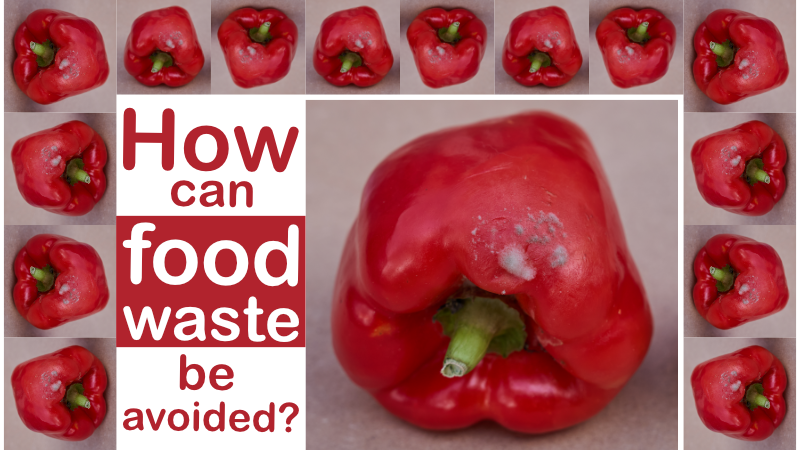
Food waste is NOT on everyone's lips! Nevertheless, it is worth taking a closer look at this specific issue in order to understand its extent and negative effects and, ultimately, to raise awareness of how and why food waste occurs and how it can best be avoided. This not only conserves valuable natural resources, but also saves money!
Too good for the bin! is the name of the campaign launched by the Federal Ministry of Food, Agriculture and Rural Affairs (BMLEH) to provide German consumers with tips on how to avoid food waste. Since the amendment to the EU Waste Framework Directive, mandatory reduction targets for food waste have been in force throughout Europe, which is why the National Strategy for Reducing Food Waste presented in 2019 is aimed not only at private households but at the entire food supply chain. With around 129 kg of food waste per capita per year, Germany is exactly in line with the EU average.1)
Cyprus leads the way with 294 kg per capita per year, followed by Denmark with 254 kg per capita per year. Spain and Slovenia generate the least waste, with 65 and 71 kg per capita per year respectively. Across Europe, approximately 60 million tonnes of food end up in the bin every year, with around 10.8 million tonnes in Germany alone (as of 2022).1) 2)If we look at the various sectors of the food supply chain, it quickly becomes clear why we as consumers are the focus of the campaign:
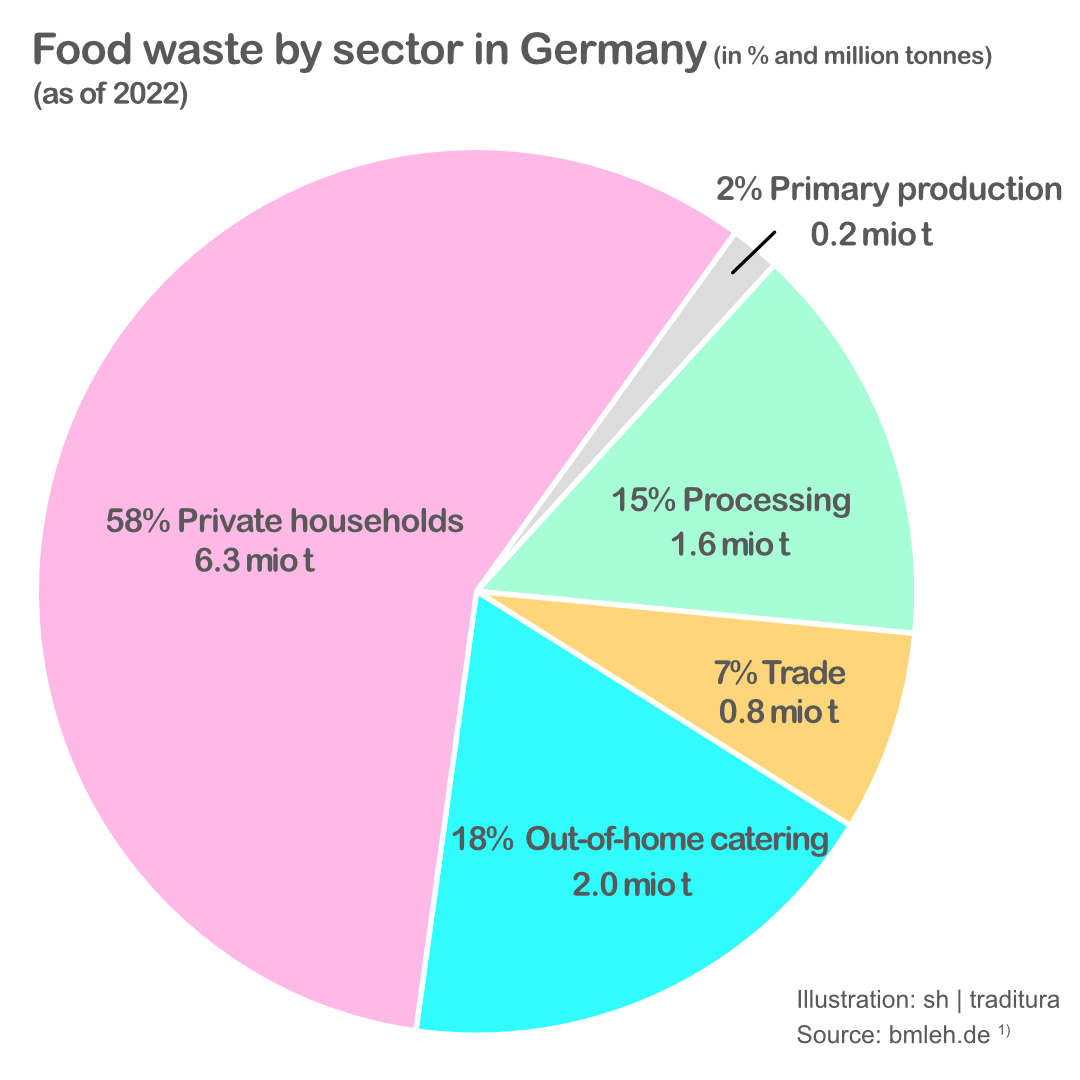
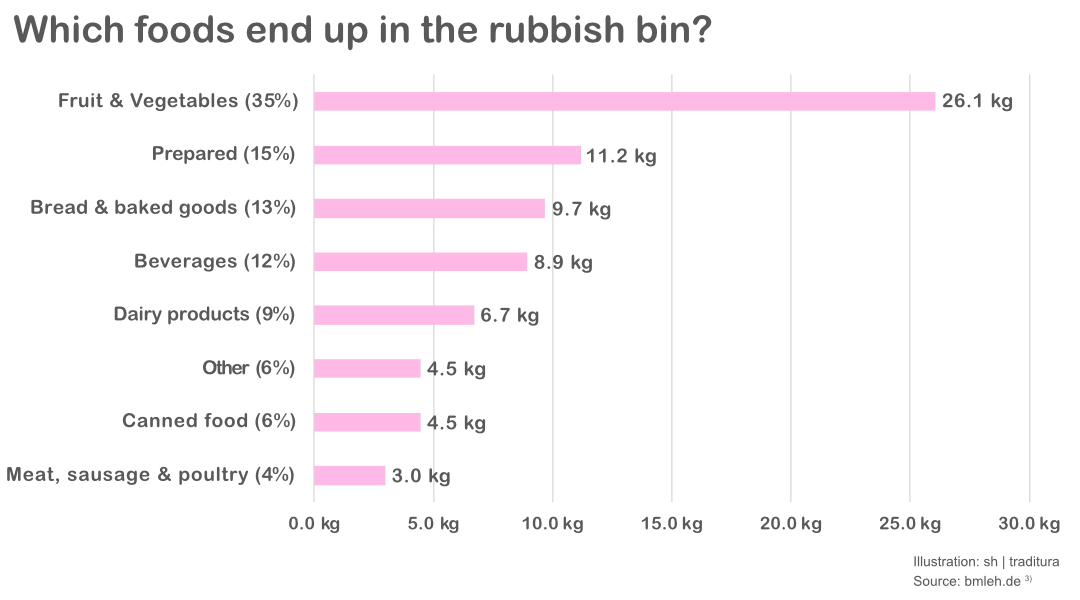
As consumers, we are responsible for more than half of the total 10.8 million tonnes of food waste. That is approximately 6.3 million tonnes generated by private households alone, corresponding to an annual food waste volume of 74.5 kg per capita on average, broken down as follows by product category3):
We should bear in mind that natural resources such as water, arable land, energy and labour are consumed not only in primary production, further processing, wholesale and retail trade, and the frequent (intermediate) transport of food. The disposal of almost 60 million tonnes of food waste also involves considerable effort, with ecological, economic and social consequences that could have been avoided, at least in part.
Before we move on to tips for reducing food waste in private households, we should first consider the most common causes of valuable food being wasted. In private households, the main causes are often:
- shopping that is not tailored to needs,
- incorrect storage of goods,
- misjudgements regarding the shelf life or edibility of products,
- preparing too large portions of food, and
- minor mishaps or incorrect or faulty preparation of food.
 So avoidable food waste is food that is still perfectly edible at the time of disposal, or would have been edible if consumed in time or prepared correctly, right?
That's right, Fritz! And that's exactly where I'd like to start with a few tips. How can we reduce our food waste using simple methods? True to the motto: Every little bit counts! ;-)
1) Good planning and needs-based shopping:
What would I like to eat in the next few days and what ingredients do I need for that? How many people am I cooking for? Am I expecting visitors? Answering these questions is the starting point for needs-based planning.
What do I still have and what do I need? Good shopping preparation takes into account not only the ingredients needed for the next few meals, but also the food still available in the (freezer) fridge or pantry. So first check your stocks, as these also influence the quantities required and should therefore be taken into account in your planning.
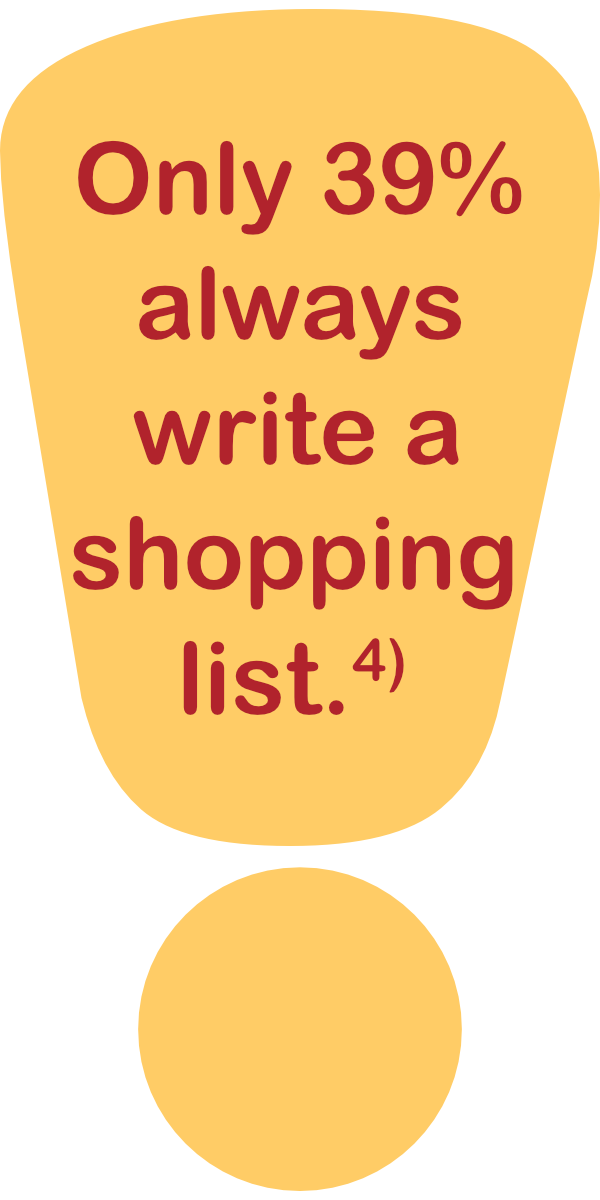 And so that we don't have to stand in front of the shelves at the supermarket and try to remember all this off the top of our heads, it helps to make a shopping list. It doesn't matter whether it's a checklist on your mobile phone or handwritten on paper. A shopping list also helps you resist tempting offers and large packs. This avoids spontaneous purchases that are not in line with your needs.
One more tip: fruit and vegetables should be purchased according to personal requirements, even if products of different sizes are sold at the same price. This is an additional incentive for retailers to offer smaller items (which then do not have to be sorted out and disposed of in advance) and, if necessary, to change their sales practice to selling by weight instead of by piece.4)
So, we have successfully completed our shopping and transported the food to our home in quantities that meet our needs. The next step is therefore to store the supplies correctly.
2) Storing goods correctly:
Food that is stored incorrectly loses its flavour or spoils more quickly, so you should at least know how to store the foods you personally prefer to eat correctly. However, as a list of all products would go beyond the scope of this article due to the large number of products available, we will make do with the different food groups and indicate how they should generally be stored.
The FiFo principle (FiFo = first in, first out) applies to all food when storing it: After shopping, new goods are sorted behind (or under) any older products that may still be present – whether in the pantry or in the (freezer) refrigerator. This ensures that the older (first in) products purchased previously are always at hand and are used first (first out).
- Bread & baked goods:
- Bread should be protected from drying out, but the environment should not be too humid. The best way to store it is therefore in a bread bin or a clay pot with a lid. There are also reusable bread bags made of linen or wax-coated bags that ensure longer shelf life and freshness.
- Crispy baked goods such as rolls are best stored in an airy place for immediate consumption, for example in a baker's bag.
- For longer-term storage, this food group can usually be frozen and then thawed or baked later. This also applies to cakes.
- Dairy products:
- With a few exceptions, dairy products are stored in a cool place. As a rule of thumb, if the product is refrigerated in the supermarket, it should also be refrigerated at home immediately!
- If dairy products are sold unrefrigerated in the supermarket, they must also be refrigerated at home after opening the packaging and then consumed within a few days. The relevant information is always printed on the packaging.
- The refrigerator has cooler and warmer zones. Dairy products should be stored in the middle of the refrigerator and either packaged separately or, ideally, in their original, well-sealed packaging.
- Meat, poultry, fish & sausage:
- These should be stored in the bottom compartment of the refrigerator (above the vegetable compartment), as this is the coldest place at 0°C to 2°C.
- Ideally, this food group should be transported home in a cool environment, for example in a cool bag or insulated bag.
- Fruit:
- Domestic fruit such as blueberries, apples, pears, cherries, plums and the like should be stored in a cool place, for example in the vegetable compartment of the refrigerator.
- Exotic fruits such as mangoes, bananas and citrus fruits do not belong in the refrigerator. But there are exceptions to every rule: figs and kiwis should be stored in a cool place.
- Some types of fruit (e.g. apples, apricots and plums) should be stored separately from other fruit and vegetables, as they release the ripening gas ethylene, which causes more sensitive foods to spoil more quickly.
Fresh fruit and vegetables can also be frozen, fermented, boiled down or pickled. If small bruises are already visible, these preservation methods are particularly useful for saving the food from spoiling prematurely. Of course, the damaged area should be removed first!
-
Vegetables:
- The vegetable compartment of the refrigerator is used to store leafy salads, cauliflower, broccoli, peas, cabbage, kohlrabi, leeks, carrots, mushrooms, radishes, beetroot, celery and asparagus.
- Cucumbers, potatoes, garlic, pumpkin, peppers, tomatoes, courgettes and onions should be stored at a cooler room temperature.
- Some vegetables (e.g. avocados, tomatoes) should also be stored separately from other fruit and vegetables, as they also release the ripening gas ethylene, which causes more sensitive foods to spoil more quickly.
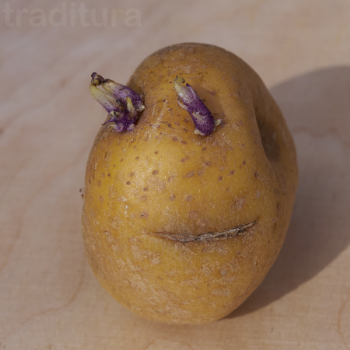
- Potatoes, garlic, cabbage, root vegetables and onions should not only be stored in a cool, dry place, but ideally also in the dark so that they do not sprout, mould or lose their flavour.
- Pasta:
- Allow cooked pasta or spaetzle to cool completely and store in a sealed container in the refrigerator.
- Dried pasta can be kept for years after its best-before date, provided it has been stored in a dry place at room temperature and in a well-sealed container.
- Canned food:
- Canned food is best stored in a cool (between 9°C and 19°C), dry and dark place in the cellar or pantry.
- After opening, leftovers should be transferred to a glass or plastic container (preferably with a matching lid) and stored in the refrigerator for two to four days at most.
- Always dispose of badly dented or bloated tins immediately, as the food inside may contain toxins or other harmful substances (e.g. rust from the tin).
- Undamaged tinned food is usually still suitable for consumption years after the best-before date.
And to achieve maximum shelf life for products, the following also applies: Ensure the necessary hygiene! Just like your hands, storage areas should also be as clean as possible. Therefore, wipe down cupboards and shelves regularly and also clean the refrigerator with warm water, a little detergent and a clean sponge. Surfaces treated with a dash of vinegar essence also prevent mould growth.5)
But let's get back to the best-before date. If undamaged tinned food can still be eaten years after this date has passed, what is the point of it being indicated on all processed foods in Germany?
3) Understanding the best-before date correctly:
The best-before date is a recommendation from the manufacturer and indicates how long a food product will retain its typical characteristics, such as colour, consistency, smell and taste, when stored correctly. It is therefore only a guide for consumers! Before throwing food away, you should always check whether it has gone off or is still edible.
So please take a close look, smell and taste before valuable food ends up in the bin for no reason!

I once used this method to test a yoghurt that was two months past its best-before date. It passed the test and tasted delicious!
ATTENTION!
The best-before date must not be confused with the use-by date. If the addition ‘use by’ is indicated instead of the best-before date, the product must be disposed of immediately after this date and must not be consumed even if thoroughly cooked!
Typical foods with a use-by date include minced meat, poultry, raw fish and pre-cut salad.
4) Prepare appropriate portion sizes or introduce ‘leftover parties’:
Above, we planned the number of people for whom we want to prepare food and derived our required quantities of ingredients from this. However, we did not take portion sizes into account. If children are eating with us, we should plan for slightly smaller portions. Older people also often eat less than someone who does hard physical work or exercises a lot, for example. We should also consider these aspects before preparing food.
However, as it is rather difficult to estimate appropriate portion sizes and we and our guests would rather have a second helping than go to bed hungry or stuff ourselves with sweets after the meal, we often cook too much rather than too little. So when there are leftovers – even if it's just a piece of meatball with two boiled potatoes from the night before, half a cheese roll from breakfast, or three tortellini with sauce from lunch still waiting in the fridge – these leftovers can be turned into the most delicious ‘leftover feasts’ for one or two to a maximum of three days.
Celebrating leftover feasts: Beautifully arranged on a large plate or served in separate bowls – some chilled, others slightly warmed, or even combined with a little creativity to create completely new dishes – leftovers invite you to enjoy a varied, hot and cold buffet. With a crisp leaf salad as a side dish, which stretches the stomach wall and thus contributes to a feeling of satiety, even a few small leftovers can become a complete meal.
Using leftovers creatively sounds exciting, doesn't it? But what if we were too creative? How can food waste be prevented in the event of minor mishaps or incorrect or faulty food preparation?
Well, when nothing can be salvaged, you have to bite the (proverbial) bullet and dispose of the food that has become inedible...
... and unfortunately, this also applies to food in the following scenarios, which probably happen to all of us from time to time: The food burns in the pot because the mobile phone rings and we just want to answer it quickly. The cream jug doesn't end up in the fridge, but falls out of our hands and the cream spreads across the kitchen floor, reminding us that we should clean it again. Or we're in love, which causes the salt content of our meal to skyrocket to inedible levels.
To compensate for this, I have a few suggestions that we can use to make an additional contribution in advance – namely when shopping for food – because these measures have a positive effect on the amount of waste generated by retailers and in the trade:
- Avoid touching and pressing loose fruit and vegetables, as this prevents the formation of rot spots.
- Don't always buy the freshest fruit and vegetables if you plan to consume them quickly anyway.
- Purposefully buy products with a close-to-expiry date if you want to eat them soon. In some shops, these items are even marked with a conspicuous sticker and available at a discount, which is also easy on the wallet!
- Some bakeries also offer goods from the previous day at reduced prices. And in terms of shelf life, it makes little difference whether you buy the bread fresh in the evening or at half price the next morning...
-
... unless, of course, you wanted to eat it for supper the night before!
sh
References:
1) BMLEH, 2026: Nationale Strategie zur Reduzierung der Lebensmittelverschwendung, taken from the internet on 10.03.2026, https://www.bmleh.de/DE/themen/ernaehrung/lebensmittelverschwendung/strategie-lebensmittelverschwendung.html
2) Europäisches Parlament, 2026: Lebensmittelverschwendung in Europa: Fakten, EU-Maßnahmen und Ziele bis 2030, taken from the internet on 10.03.2026, https://www.europarl.europa.eu/topics/de/article/20240318STO19401/lebensmittelverschwendung-in-europa-fakten-eu-massnahmen-und-ziele-bis-2030#wichtige-fakten-und-zahlen-fr-europa-9
3) BMLEH, 2026: Fragen und Antworten zum Pakt gegen Lebensmittelverschwendung. Wie viele Lebensmittelabfälle entstehen jährlich in Deutschland? Taken from the internet on 10.03.2026, https://www.bmleh.de/SharedDocs/FAQs/DE/faq-pakt-lmv/FAQList.html#f104616
4) BMLEH, 2026: Tipps für zu Hause - Gut planen. Taken from the internet on 10.03.2026, https://www.zugutfuerdietonne.de/tipps-fuer-zu-hause/gut-planen
5) BMLEH, 2026: Tipps für zu Hause - Richtig lagern. Taken from the internet on 10.03.2026, https://www.zugutfuerdietonne.de/tipps-fuer-zu-hause/richig-lagern